Tuesday, 8 November 2016

Paper 10 Fire and Ice poem by Robert Frost.


To Evaluate my assignment click here.

S. B. GARDY DEPARTMENT OF ENGLISH


M.K.BHAVNAGAR UNIVERSITY.

 
Name:- Vala Jyotsna Tanshukhbhai


Semester: - 3


Roll no: - 33


Enrollment No: - PG15101042


Year: - 2016-17


Paper Name: - 10


Topic: - Fire and Ice poem by Robert Frost.


Introduction:-
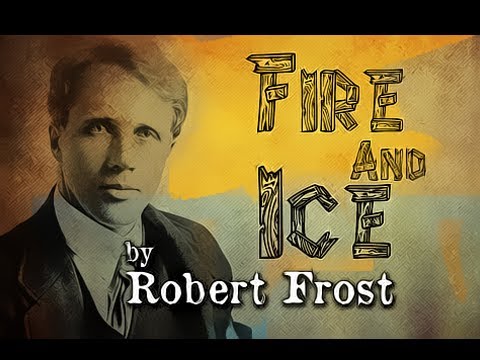


 Image result for Robert Frost.


BORN - March 26, 1874 in San Francisco, California


DIED - January 29, 1963.


OCCUPATION poet , Playwright.


NOTABLE AWARDSPulitzer Prize for Poetry, Congressional
 
                                         Gold Medal.


Cleanth Brooks says.......


Frost’s best poetry exhibits the structure of symbolist poetry. 
Much more clearly than does of many a modern poet”.


           “Critics say that Frost was a poet of Pastures and pain ,
            Mountain and rivers , woods and garden , fruits and  
              flowers , seeds and birds”


His famous works :-


Fire and Ice”

The Gift Outright”

 “Design”

 “Mending wall”

 “Home Burial”


About his poem :-

Fire and Ice :-

Some say the world will end in fire,

some say in ice.

From what I've tasted of desire

I hold with those who favor fire.

But if it had to perish twice,

I think i know enough of hate

To say that for destruction ice

Is also great

and would suffice


Introduction : -


The poem suggests that both desire and hate are 

strong emotions that could bring destruction, 

sadness, devastation to the world. Destruction of 

human lives destruction of human relationship 

within others destruction of the nature.


The speaker considers the age – old question of 

whether the world will end in fire or in ice. This is 

similar to another age-old question whether it 

would be preferable to freeze to death or burn to 

death. The speaker determines that either option 

would achieve its purpose sufficiently well.


Meaning of the title :-


Fire and Ice

Fire :- Pain, Desire

Ice :- Indifference, Hate
Image result for Fire and Ice by Robert Frost.


Theme :-

Theme that means central idea about this poem. 

“Fire” it is symbol for desire, “Ice” it is a symbols 

for hate. Both are connected with human nature so,  

Relationship is one of the main theme of the poem.


Symbols :-

Symbolism is a literary device that contains several 

layers of meaning. Meaning forms generally it is an 

object representing another to give it an entirely 

different meaning that is much deeper and more 

significant.


The concepts of Fire and Ice carry with them deep connotations 
that, in and of themselves, prompt the recollection of the 
sensations they embody.For example Fire elicits the feeling of 
heat and light, but also burning and pain.This particular image is 
well used by Frost to create a duality with both Fire and ice that 
then draws attention to the nature of the warning he creates.


Symbolism:


 Symbolism is the key to this poem. Frost very explicitly makes 

 symbols as given below.


Fire: Warmth, Emotions, Desire


Ice: Coldness, Dryness, Hatred


 Both are extremes and these extremes lead towards destruction. 

 Fire symbolize for desire, and ice symbolizes here for hate. This 

 coupled with the imagery that these symbols evoke and creates a 

 multidimensional complexity to the poem. Because of the deeper 

 meaning that fire and ice takes on the application and 

 understanding of the poem is altered.


Metaphor : -


"Some say the world will end in fire,

                          some say in ice."


Fire, Ice, World.


Fire
 Image result for Fire and Ice by Robert Frost.

Desire : - Desire is most often connected with passion, love and 

sex but it can also be connected with wealth or power.


Ice

 Image result for Fire and Ice by Robert Frost.

Hatred : - Hatred is usually associated with burning, but frost 

makes this hate cold and calculating.


World

Life : - “The world will end” (Line 1).
                 “Parish ( Line 5).

Death is connected with life, Perish brings up image of human life.


Imagery : -


 Stanza 1 Line 1

Some say the world will end in fire”


 This line contains two imageries. The visual imagery here can 

 encourage the readers to think that when they see fire it seems 

 like very terrible thing. Mean while the tactile imagery makes the 

 readers feel that fire is very very hot and dangerous.


 Stanza 1 Line 2


  Some say in Ice”.


The visual imagery with the world ice makes the 

readers imagine that ice is a very horrible thing too. 

The tactile imagery makes the readers feel that ice 

will make them freezing.


 Stanza 1 Line 6


I think i know enough of hate”


Organic imagery can be found in this line in the 

word hate because hate comes natural from 

someone's heart.


Stanza 1 Line 7


To say that for destruction ice”


 This line proposes kinesthetic imagery because the 

 readers can assume the word say do a movement or 

 tension about the destruction of ice is also great.


Analysis :-


 This short poem of Robert Frost interprets his own 

 thinking about how probably the earth would be 

 destroyed the Indian oriental myth and western 

 myth both suggest that there would be the end of 

 this earth. The Indian oriental myth suggest that  

 the earth would be destroy because of water and 
 
 western Christian myth suggest the earth would be 

 destroy of fire. The present poem shows the poet 

 thinking about it.

 Some people are of the opinion that the earth would 

 be destroy because of fire while some other think 

 that the earth would be destroyed because use of  

 ice, water, the poet has made is study about desires


 of the people on the basis of that study the poet 

 comes to a conclusion that the earth would be 

 destroyed because the fire of never ending desires 

 but in the some earth is to be destroyed twist, the 
 
 second time it would be destroyed because of ice.

 The poet here refers to cold blooded hatred which 

 allow a person the very cool but full of hatred and 

 venom from inside so, from the second time it the 

 earth destroyed because of cold blooded 

 temperament with which remain covered modern

 man's hatred so, both Fire and Ice equally capable 

 of destroying the earth.


Conclusion :-


Fire and Ice” is only poem of nine lines. Through this short 

poem Frost conveys his ideas and he succeeded in opening our 

eyes for deeper meaning.


 Desire to Fire and haste to ice are haste to ice are human 
 
 emotions, transformed into impersonal forces. This poem is a 
 
 lyric, which also expresses the poet’s dreaded acceptance of the 

 passion both of love and hatred in their most destructive from.


 http://hiteshgalthariya2014-2016.blogspot.in/2015/10/robert-frost-

 as-poet.html 


To Evaluate my assignment click here.

Monday, 4 April 2016

Characteristics of Romantic Age.


To evaluate my assignment click here.


Characteristics of Romantic Age

S. B. Gardi DEPARTMENT OF ENGLISH

M.K.BHAVNAGAR University
Written by:- Vala Jyotsna T

Course No:-05

Course Name:- The Romantic Literature Enrollment no :- PG15101042


Characteristics of Romantic Age(1800-1850)

Introduction:

This period from (1800-1850) according to the William.J.Long is known as the age of romanticism or age of Wordsworth generally the duration between 1798 to 1827 is known as romantic period. This period is considered one of the most creative period in the history of English literature. It brought intense change in the production of literature especially in poetry field.
    
                S.C.Agrawal remarks.....
                           
The close of 18 century is characterized by a dramatic change in the history of Europe. In the period of few years its face, thought and literature underwent a remarkable change.
This change manifested in the fury of French revolution. In the industrial  and the scientific. In the literary revolution to which we have given the name of    “The Romantic Revival”.

The word “Revival” indicates a written to something which existed in some previous age and in literature. This return is to those romantic quality which were found in the literature of Elizabethan age.

Definition of the of the term “Romanticism”

Victor Hugo says:-
                               
                                   “Romanticism” is the opposite not of classical but of realism in literature.

George say:-

                           “Romanticism emphasizes on emotion rather than reason the heart opposed to head”.

Rousseau says:-

                              “Romanticism” is means the return to nature.

Girerson says:-

                               “in Romanticism the spirit count more then form.”

Characteristic of Romantic age:-


(1). Romantic enthusiasm

(2). An age of poetry

(3). Return to nature

(4). Woman as novelists

(5). Sympathy for the poor

(6). Modern magazines

(7). Element of Supernatural Power

(8). The age of Symbols and Myths

Romantic enthusiasm:-  

                                   The essence of Romanticism  was that literature must reflect all that is spontaneous and unaffected in nature and man. In the age of Romanticism ,we can see this independence expressed in Coleridge's “Kubla Khan” and “The Rime of Ancient Mariner”. These two are dream picture- one dealing with the orient and the other of a lonely sea. In Wordsworth this literature independence led-him inward to the heart of common thing. These two great poets,Coleridge and Wordsworth represent the Romantic genius of the age.


An age of poetry:-


                                    The Romantic age is basically an age of poetry. The previous century the Neo-classical age was largely the age of prose. While during the age of Romanticism the young writer turn to poetry as a happy man o singing.

                                   The glory of this age can be found in the poetry of Wordsworth, Coleridge, Byron, Keats and Shelly. Romantic poetry is a spontaneous overflow of powerful feeling. The Romantic poet is gifted with a strong “Organic Sensibility”.


Women as Novelists:-

                                        For the first time woman took importance role in contribution to the English literature. This age was highly emotion as the woman are more emotional. This spirit of this age gave then the opportunity to expressed themselves in literature. One of the first important woman writer is Mrs.Anne, Jane Austin etc... Her novel become very popular and impress.


Sympathy for the poor:-

                                            Romantic age was marked by human sympathy and by understanding  of the human heart. The Romantic poets unlocked their emotion and feeling and reflected their sympathetic nature certain common subject like a bigger, a country girls, a farmer, a shephered are create in the poetry of Romantic poets.


The Modern Magazines:-

                                             In this age literary criticism was established by the appearance of such Magazines as  
       
          “Edinburgh Review” (1802)

         “The Quarterly Review” (1808)

         “Black woods Magazine” (1817)

         “The Spectator” (1828).

                                             
 These magazines put their influence on all subsequent literature. These magazines were published the work of certain writers like- Charles lamb and gave the opportunity to every writer to make his work known to the world.


Return to Nature:-


Again, this is one of the important characteristic of the Romantic Age. We can also say that the whole age is marked by this characteristic. During this age the writer used the elements of nature to satire on the society. Yes, it is true that most of the people think that this was the time when the writers don’t use satire to reform the society. But that is not true the satire during this time was in an indirect way. The concept of Romanticism becomes quite clear here. We think that romanticism is something related to the physical world. Yes, it is but in a wilder way. Romanticism reflects the nature. Nature is which we see around us like trees, plants, birds, animals, and sea etc. and also the nature of Men. It includes both the meaning at a time. Through using the elements of nature the writers of this time tried to talk about the nature of human beings. Wordsworth’s poem ‘Daffodils’ is the best example.

“I wandered lonely as a cloud
That floats on high o’er vales and hills”


These are just two lines of the poem. But in these two lines also we can see the natural environment created by the poet. When we look at this poem at the surface level we can understand very easily that this is the language used for the common men. I want to give other illustration here that is the novel ‘Frankenstein’ written by Mary Shelly which is the best example of the Nature. Though at surface level we will not be able to find the Nature in this novel but if we analyze this novel in deep then we will be able to find the Natural elements. The major part of this novel talks about the Nature only, because Victor wanted to go against the Nature. The other example of nature I would like to give of John Keats though when he was living he never considered as a great writer. He got fame after his death. And he also died at a very young age. It was said for Keats that he was the priest of beauty as Wordsworth is the priest of the Nature. Here are some lines from Ode to Psyche.

“Yes, I will be thy priest, and build a fane
In some untrodden region of my mind”


Elements of Supernatural power:-


These are the two lines in which Keats is praising the beauty of Psyche and says that I will make a temple in my mind so that no one can enter in my mind and I will always worship you in my mind as a goddess. So, here these lines become true that he is the priest of beauty. He uses nature to praise the beauty.


“Thee sitting careless on a granary floor,
Thy hair soft-lifted by the winnowing wind;”

These are other lines from Keats’ another ode ‘Ode to autumn’. He was the poet who celebrates the beauty of autumn. That is why he was so criticized by the other writers of his time and especially by Wordsworth.


Again this characteristic takes us to the roots of this time and that is the endless debate ‘Art for the Art’s sake’ and ‘Art for the Life’s sake’, because this characteristic is in the favor of ‘Art for the Art’ sake’. This characteristic is also connected with the characteristic of imagination. Supernatural power means something which as a human being we don’t have or if I say in other words then beyond the human capacity. As above said that during this time people were aware about their selves and the center was also the individuality. So, many writers tried to give supernatural elements to their characters. The poets of the neo classical age gave more importance to realistic descriptions of day to day life. The romantic poets like Coleridge however, concentrated on describing the supernatural world. The whole poem describes the supernatural and mystical experience of the "Ancient Mariner" in a mysterious manner:

This seraph band, each waved his hand:
It was a heavenly sight!
They stood as signals to the land,
Each one a lovely light:

Here again if I give the example of ‘Frankenstein’ by Mary Shelly then in this novel she tried to give some supernatural touch. During those days electricity was the new invention by human beings. Accordingly, Frankenstein abused electricity, a natural force, to stimulate ‘the lifeless thing’ (Shelley 34). By artificially and miraculously bringing his inanimate project to life, Frankenstein leaves the ordinary course of nature and produces something abnormal and supernatural.


The age of Symbols and Myths:-


                                        With all these characteristics this age is also marked especially for the myths and symbols used by the writers during this time. Human was the center and the symbols and the myths were of the nature of this time. And the symbols and myths were also taken seriously by the people of that time because it suggests many things. We can say that writers used the sugar coated language to highlight the mistakes of the society of that time. Again I would like to give the example of John Keats and his ode ‘Ode on a Grecian Urn’. In this ode he uses many myths. According to Keats urn is like time it knows everything the past as well as the future also. He also depicts some people on this urn that some of them are playing flute pipe and some of them are doing their work. He also depicts a couple. According to Keats the lovers are happy as well as unhappy because they will remain there on that urn always but they can’t touch each other and that is why Keats writes that:

“Heard melodies are sweet, but those unheard
Are sweeter;”

It is a kind of symbol used by Keats to showcase the reality of the life.


Conclusion:-
                       

To conclude, the period between 1798-1832 Romanticism brought a drastic change in the production of poetry. It was remarkably a strong movement, “The Return to Nature” the leading Romantic poets.

                     
Thus the Romantic age gave us nature, love sympathy and inspiration the man found his existence hidden in the heart of others. The man went to nature to take rest and sang the love song of nature.

To evaluate my assignment click here.